Catering Proposals That Close: What to Include and What to Skip
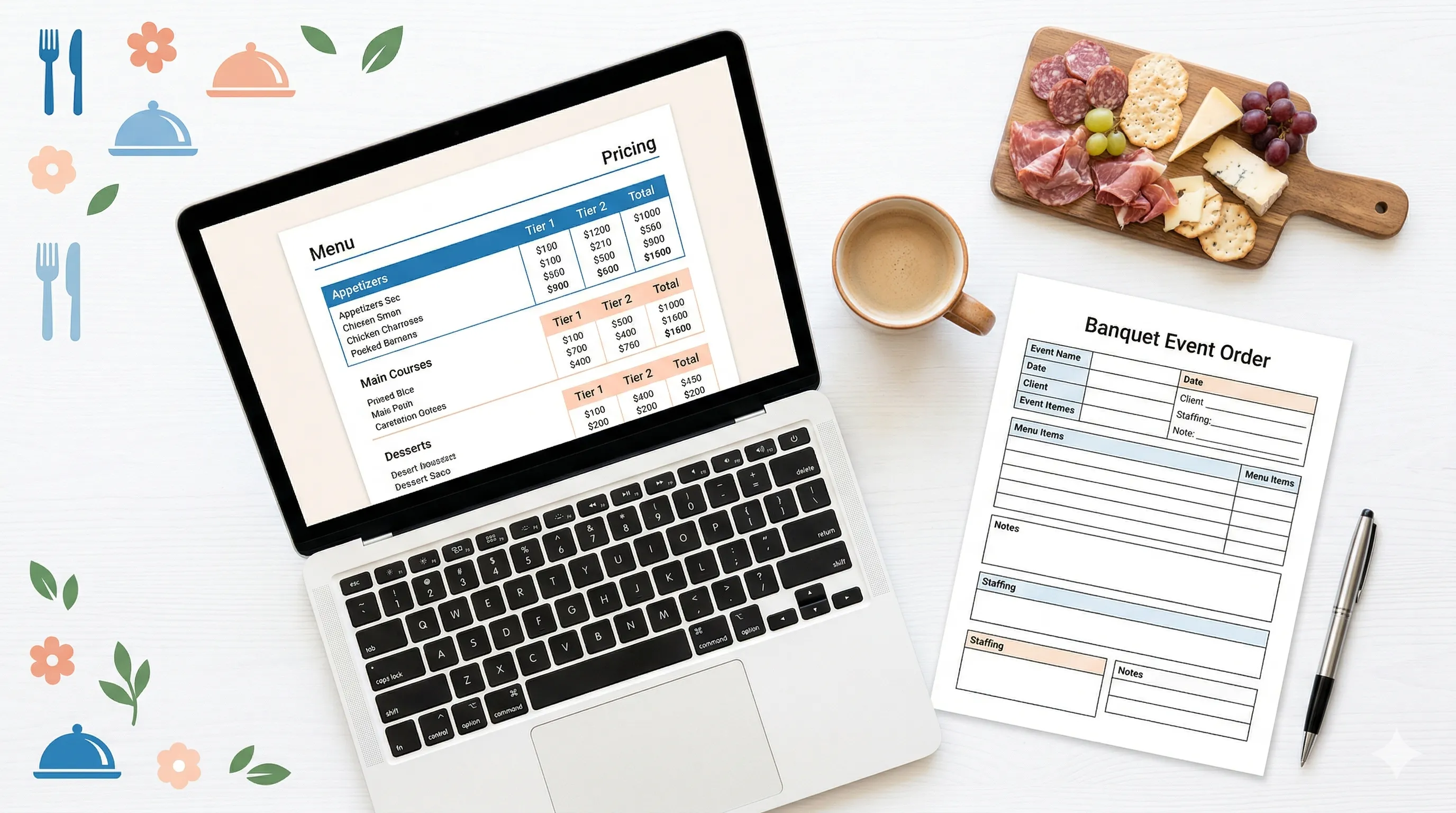
There’s a pattern that plays out in catering businesses every week. A lead comes in… corporate holiday party, 200 guests, full service. You spend an afternoon putting together a thorough proposal. Menu options, staffing breakdown, rental inventory, dietary accommodations, beverage packages, setup and teardown details. You send it over. It’s comprehensive. It’s professional.
And then the client goes quiet for two weeks.
When they finally respond, it’s one of three things: they went with someone else, they want to “simplify” (code for: cut the budget), or they ask you to re-quote with different menu options — which means starting the whole process over.
The proposal wasn’t wrong. It was just doing too much work at the wrong stage of the relationship.
The best catering proposals don’t try to answer every question the client might ever have. They answer the eight questions that actually drive a decision, skip the rest, and make saying yes feel simple. This is the framework.
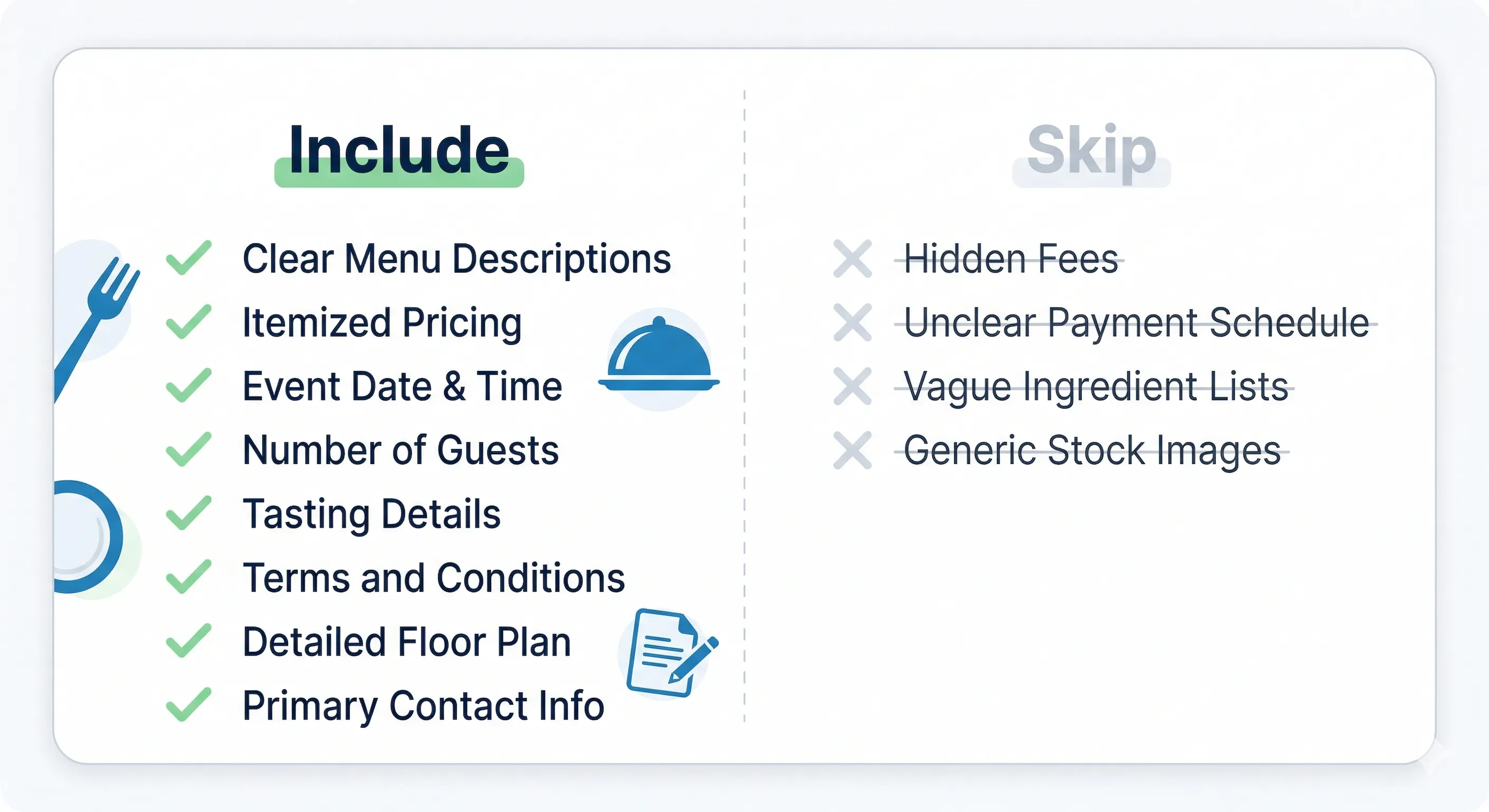
The 8-Point Catering Proposal Framework
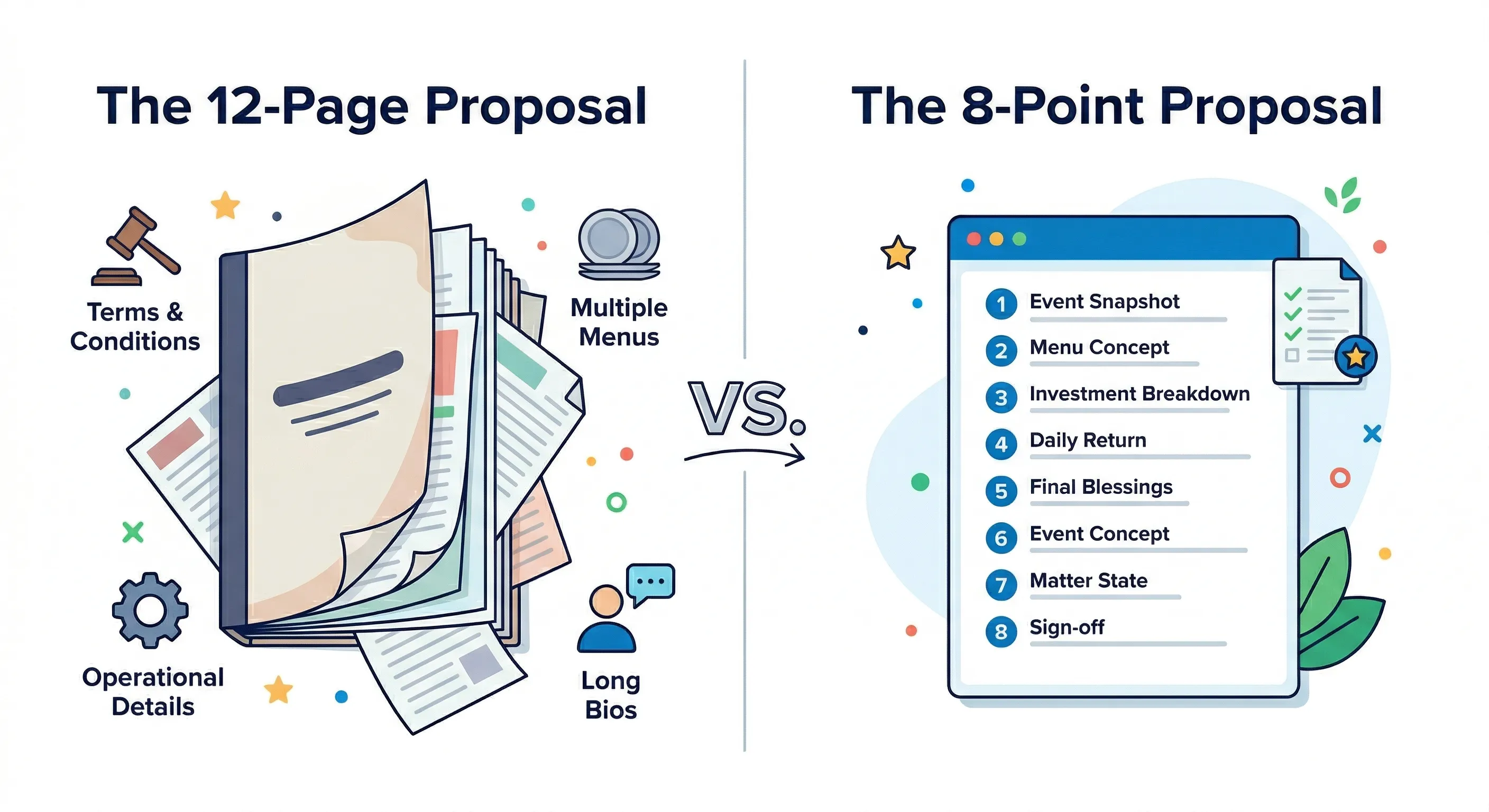
Most catering proposal advice tells you to “be thorough” and “include everything.” That’s the wrong instinct. Thoroughness doesn’t close deals — clarity does. A 12-page proposal with every possible line item, every policy caveat, and every menu substitution gives the client homework instead of a path forward.
The framework below covers what needs to be in every catering proposal that’s designed to convert, not simply inform.
1. The Event Snapshot
Before anything else, the proposal should prove that you listened. Open with a concise summary of what the client told you: the event type, date, venue, estimated guest count, service style (plated, buffet, stations, family style), and any specific requirements they mentioned during the consultation.
This takes three to four sentences. Its purpose isn’t to fill space. It’s to make the client feel understood before they’ve even looked at the menu. When a client sees their own event reflected back accurately in the first paragraph, trust goes up immediately.
2. The Menu Concept
This is where most caterers over-invest in the proposal and it backfires. The temptation is to present three to four full menu options with every course detailed, every ingredient listed, and every dietary variation spelled out. The result is a document that reads like a restaurant menu crossed with a textbook.
What works better is a curated menu concept: one recommended menu that aligns with what the client described, with a brief note that alternatives are available. Present the appetizers, main courses, sides, and desserts you’d actually recommend for this specific event. Use descriptive but concise language. The client doesn’t need to know every ingredient in the vinaigrette — they need to see that the food matches the tone of their event.
If you want to offer options, present two menu directions at most. Not four. “Classic Elegance” and “Modern Garden” give the client a meaningful choice without creating analysis paralysis. Each direction should be a complete, cohesive menu, not a mix-and-match buffet of individual items.
3. The Per-Person Investment
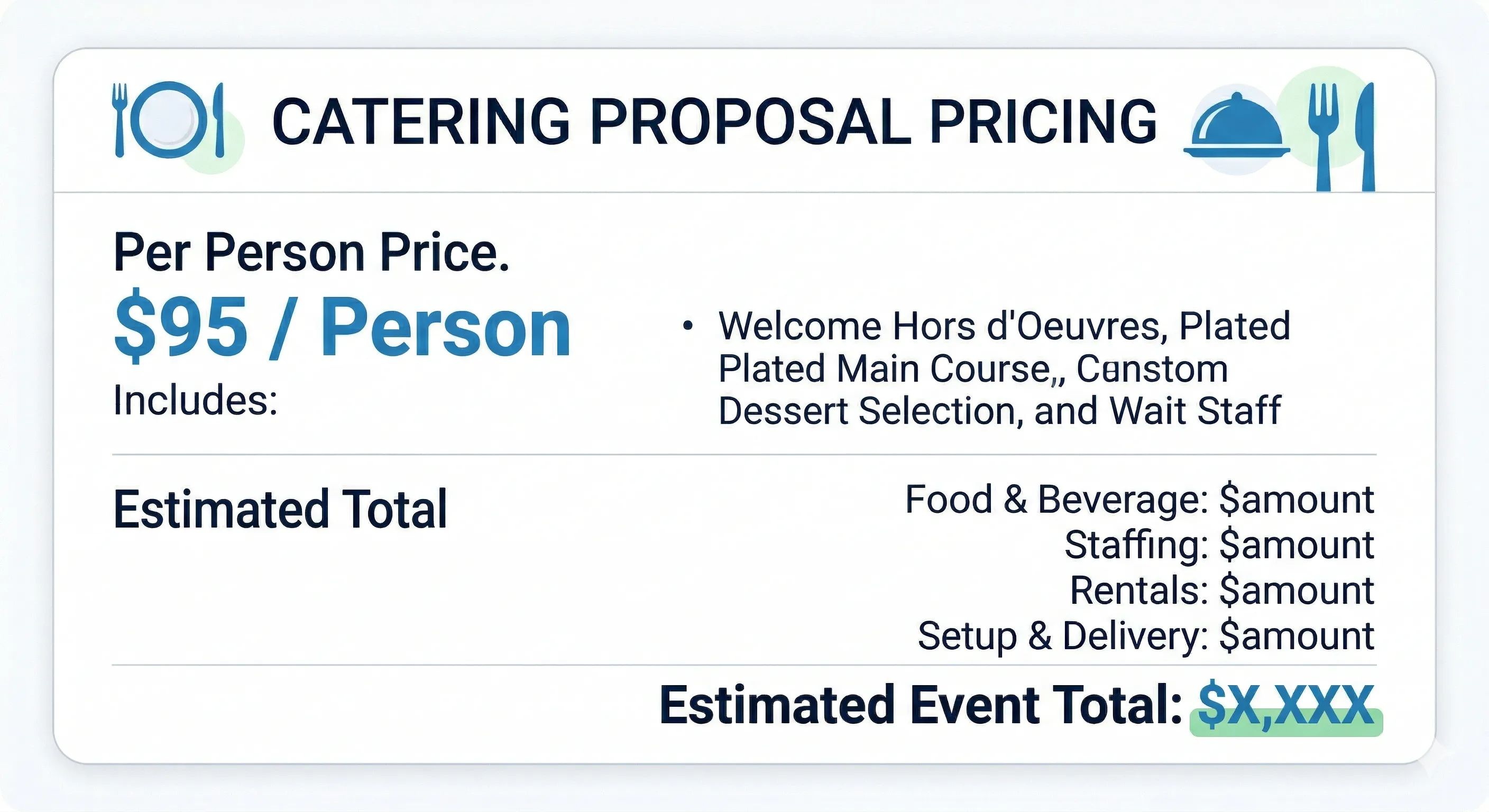
Price the menu per person, clearly. This is the number the client is comparing to every other caterer who quoted them. It should be easy to find, easy to understand, and not buried on page seven.
A strong format: “$95 per person: includes appetizer hour, plated dinner (choice of two entrees), dessert, non-alcoholic beverages, staffing, and standard tableware.” One line. Complete. No ambiguity about what’s included.
Avoid ranges like “$75 to $120 per person depending on selections.” Ranges feel evasive and force the client to do math to figure out their total. If your menu options genuinely produce different price points, present each one with its own fixed per-person number.
4. The All-In Total
Below the per-person price, show the estimated total based on their quoted guest count. Include the line items that make up that total: food and beverage, staffing, rentals (if applicable), delivery and setup, and any service fees or tax.
The key word is estimated. Make it clear that the final total is based on the confirmed guest count, and explain when that confirmation is due (typically 10 to 14 days before the event). This protects you from being locked into a price before the scope is final, while still giving the client the number they need to make a decision.
5. The Staffing Plan
Clients don’t want a staffing spreadsheet, but they do want to know that you’ve thought about it. A brief staffing summary builds confidence that the event will run smoothly without the client having to manage logistics themselves.
Keep it simple: “For an event of this size, we recommend a team of one event captain, four servers, one bartender, and one kitchen lead. Our team handles all setup, service, and breakdown — you and your guests won’t need to lift a finger.”
That’s it. You don’t need to list hourly rates, overtime policies, or staffing contingency plans in the proposal. Those belong in the contract if the client asks, not in the document that’s supposed to close the deal.
6. The Timeline
Include a high-level event timeline, not a minute-by-minute run sheet. The client wants to see that you’ve thought through the flow of the evening, not that you’ve scripted every server’s movements.
A strong timeline hits four to five beats: setup window, guest arrival and cocktail hour, dinner service, dessert, and breakdown/departure. Attach approximate times. This signals competence and planning ability without overwhelming the client with operational detail they don’t need at the proposal stage.
7. Dietary and Allergy Accommodations
Address this briefly and proactively. Even if the client didn’t mention specific dietary requirements, include a sentence that says you accommodate them: “We’re happy to accommodate any dietary needs, including gluten-free, vegetarian, vegan, and common allergen restrictions. We’ll confirm all dietary requirements with you during the planning process.”
This is a trust signal. It tells the client you’ve done this before and they don’t need to worry about Uncle Steve’s nut allergy being a crisis on the day of the event.
8. The Clear Next Step
Every proposal needs exactly one call to action. Not three options for how to proceed. One. “To confirm this date, sign the agreement below and submit your deposit of $X. We’ll follow up within 24 hours to begin the planning process.”
The biggest mistake caterers make at the close of a proposal is being passive. “Let us know if you have any questions” is not a next step. It’s a polite way of saying “the ball is in your court and we hope you come back.” A direct, specific next step — sign, deposit, done — respects the client’s time and moves the process forward.
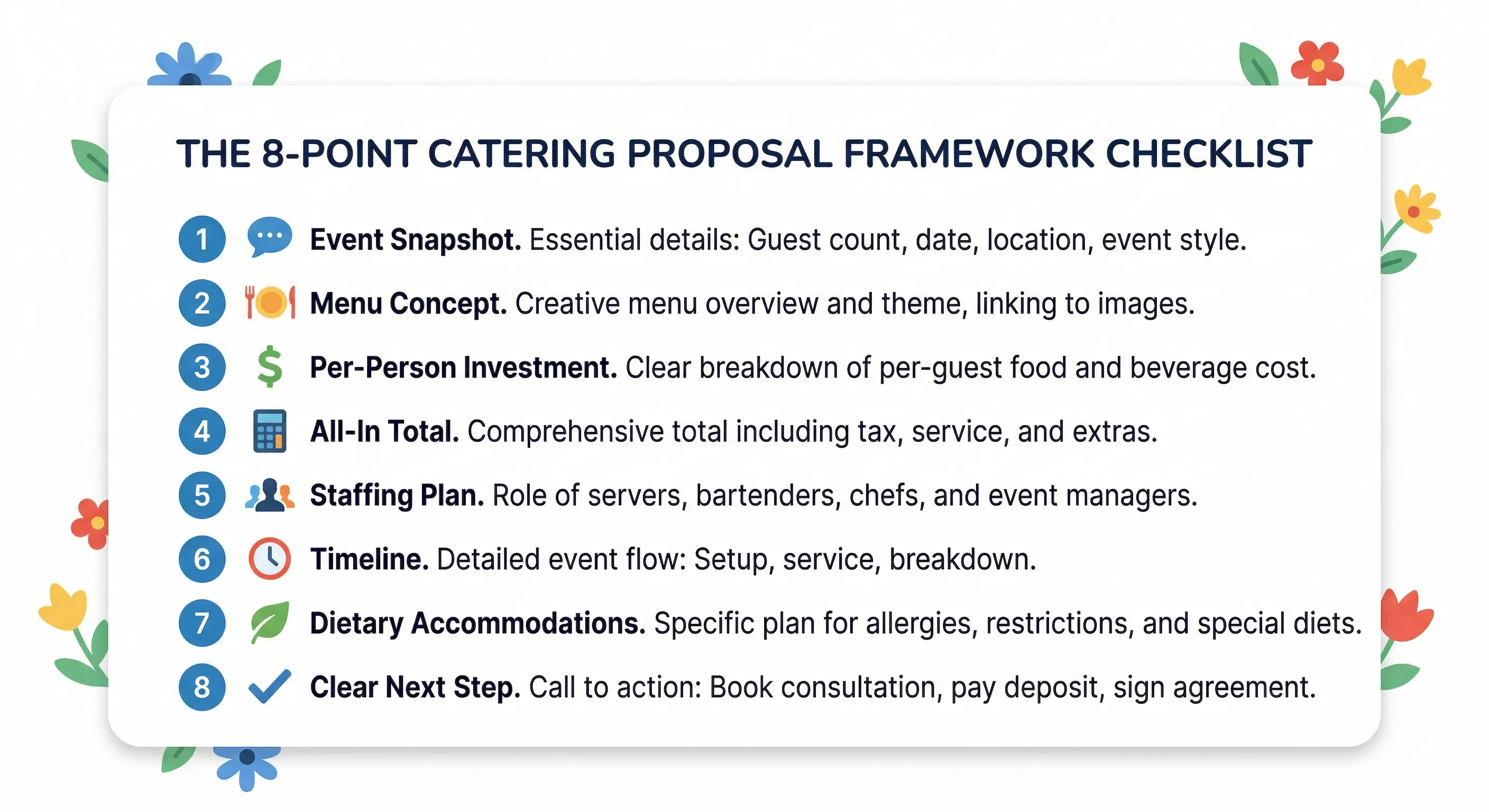
What to Leave Out (and Why)
Knowing what to include is half the framework. The other half is knowing what to cut. These are the four most common proposal elements that feel important but actively slow down the close.
Full terms and conditions. Your cancellation policy, liability disclaimers, force majeure clause, and payment schedule are essential — but they belong in the contract, not the proposal. Mixing legal language into what should be an exciting, visually appealing document kills the mood. The proposal sells the experience. The contract protects the business. Keep them separate, even if they’re delivered together.
Exhaustive menu alternatives. Presenting four complete menu options with substitution notes and seasonal availability disclaimers turns the proposal into a restaurant guide. The client didn’t ask you to present everything you can cook — they asked you to recommend what’s best for their event. Curate down to one or two strong options and save the customization for the planning phase after they’ve signed.
Internal operational details. Your kitchen workflow, vendor sourcing strategy, food safety certifications, and equipment inventory are important to your business. They’re invisible to the client and should stay that way. The client doesn’t need to know how the sausage is made — they need to trust that it will arrive on time, taste excellent, and be served professionally.
Long company bios. A sentence or two about your experience is useful context. Three paragraphs about your founding story, your philosophy of food, and your chef’s culinary journey is padding that the client will skip. If your work is good, the proposal itself demonstrates that. Let the portfolio photos and the menu concept do the talking.
Speed Closes More Deals Than Perfection
Most catering proposals take too long to build. Not because the information is hard to assemble, but because the process involves too many disconnected steps: pulling menu descriptions from one document, pricing from a spreadsheet, images from a folder, and formatting it all in Word or Canva before exporting a PDF and emailing it.
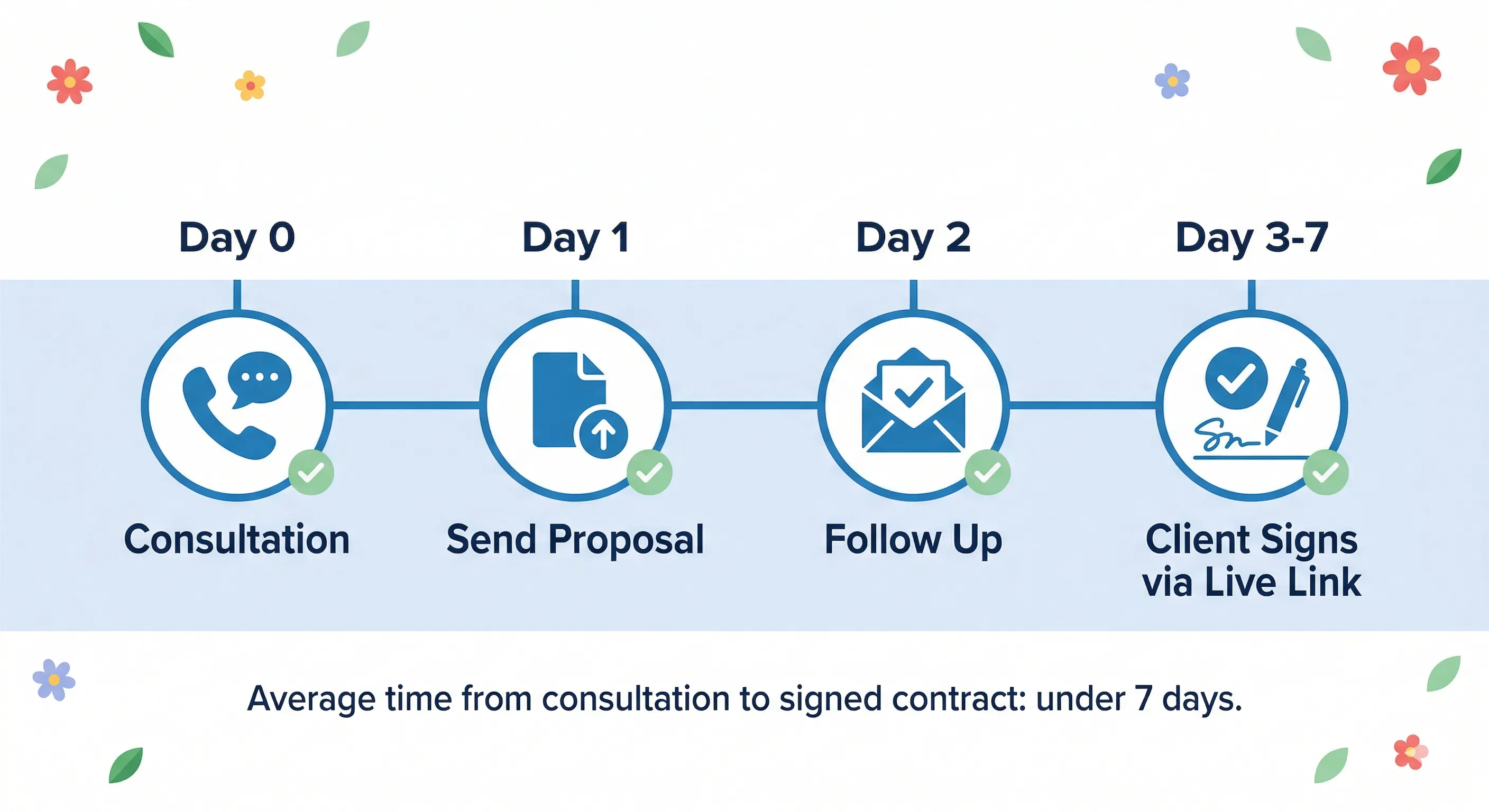
The data on response speed is clear. According to D-Tools research, proposals delivered within 14 days have an 88% close rate. Proposals that take more than 60 days drop to under 70%. And according to Proposify’s State of Proposals report, winning proposals are typically acted upon within two days. Event planners specifically expect proposals within 24 to 48 hours. Every day beyond that window, momentum fades and competitors gain ground.
The caterers who win more often aren’t necessarily better cooks. They’re faster responders. A client who receives a polished, clear proposal within 24 hours of their inquiry feels prioritized. A client who waits a week feels like an afterthought.
This is where the tool matters. Static documents (Word, Canva, PowerPoint, even generic proposal software) require manual assembly for every event. You’re copying, pasting, reformatting, and re-calculating every time. When the client wants to swap the plated dinner for a buffet, or add a cocktail hour, or change the guest count from 150 to 200, you’re back in the file rebuilding.
Connected proposal software changes this dynamic entirely. When your proposal is built from templates that pull from your existing menus, your pricing automatically adjusts to guest count changes, and the client receives a live link instead of a PDF attachment, the entire cycle accelerates. You make a change and the client sees it instantly at the same link. No re-exporting, no version confusion, no “which PDF is the latest one?” emails.
And the proposal is only the front end. The best systems also generate your operational documents automatically from the same data. Your BEOs, packing lists, shopping lists, and event prints all pull from the proposal — so you’re not re-entering the same information into a separate document for the kitchen. You build the proposal once, and everything downstream follows.
When the client is ready to commit, the contract is built right into the proposal. They review the scope, sign the agreement, and submit their deposit in one flow. No separate DocuSign email. No “I’ll send over the contract separately” delay. That gap between “I love it” and “I’ve signed” is where more catering deals die than most operators realize. Eliminating it is one of the highest-leverage things you can do for your close rate.
The Follow-Up That Matters
Sending the proposal is not the finish line. What you do in the 48 hours after sending determines whether the deal moves forward or drifts.
The best practice is simple: send the proposal, then follow up the next business day with a short note. Not a “just checking in” email — a specific, helpful touchpoint. Something like: “I wanted to make sure the proposal came through clearly. The menu I recommended was based on what you described for the venue and guest count — happy to adjust anything if your plans have shifted.”
This does two things. It reminds the client to look at the proposal if they haven’t yet, and it signals that adjustments are easy and welcome, which reduces the fear of committing to something that feels locked in.
If you haven’t heard back within a week, one more follow-up is appropriate. After that, the lead is cooling and you’re better off investing energy in new opportunities than chasing silence.
The Proposal as a Preview of the Experience
Here’s the thing most caterers don’t think about: the proposal is the client’s first real experience of working with you. Before the tasting, before the planning meetings, before the event itself — the proposal is where they form their first impression of what you’re like to work with.
If the proposal is slow, disorganized, and hard to navigate, that’s the experience the client expects from the rest of the engagement. If it’s fast, polished, and clear, they’re already confident they made the right call.
The eight-point framework keeps your proposal focused on what matters. But the delivery matters more: how fast it goes out, how easy it is to navigate, how seamless the revision and signing process feels. That’s what separates caterers who are always quoting from caterers who are always booked.
Curate helps caterers send polished proposals in minutes, not days. Your client gets a dedicated live link that updates in real time. No re-exporting PDFs after every change. Your BEOs, packing lists, and shopping lists generate automatically from the same proposal data. And when the client is ready, the contract and payment collection are built right in. One link. One flow. Signed and booked.