Mother's Day Prep: Batching Floral Recipes for High-Volume Success
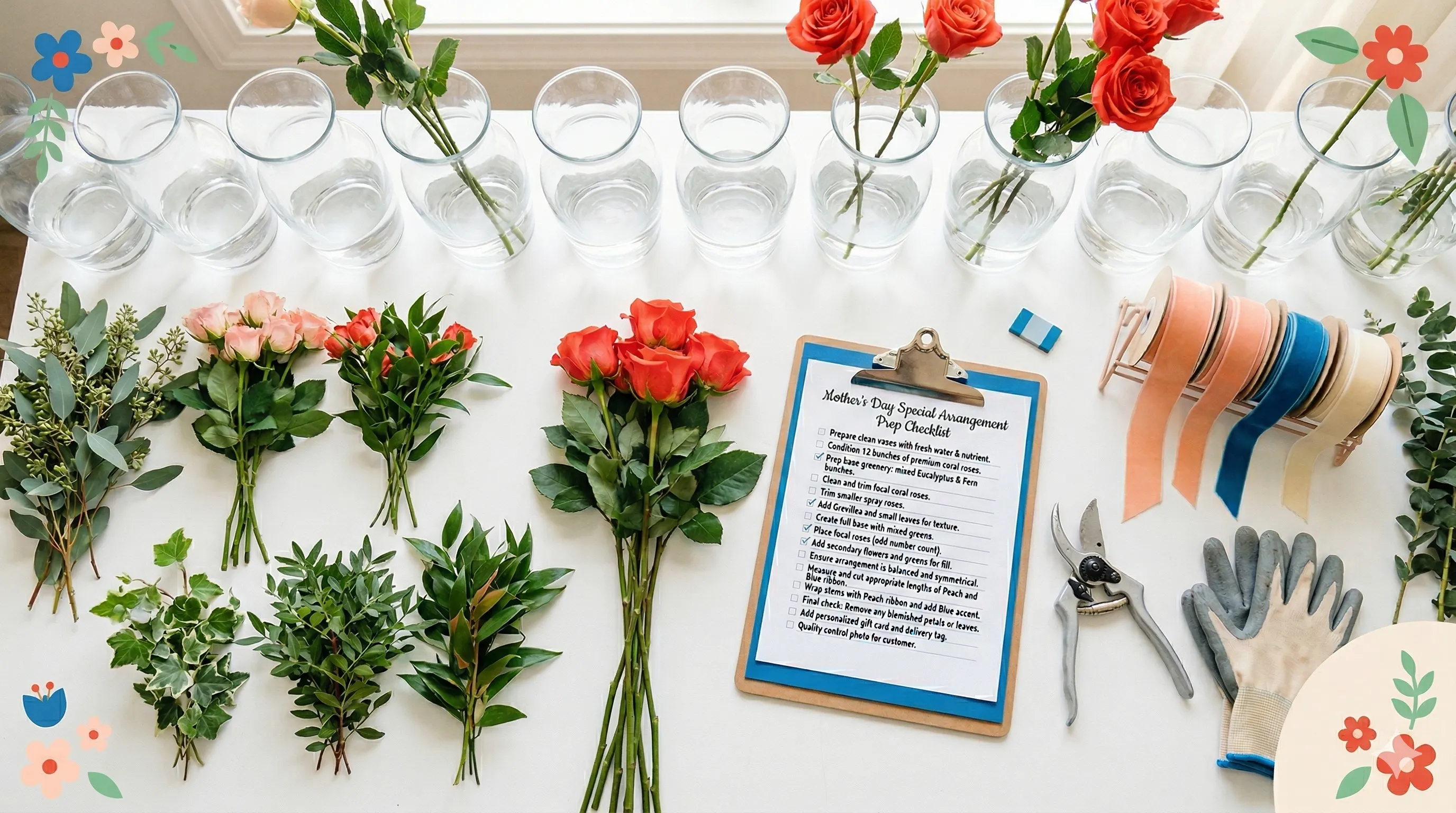
Mother’s Day is the second-largest single-day revenue event for most florists, behind only Valentine’s Day. According to the Society of American Florists, Mother’s Day accounts for roughly 26 percent of all holiday floral transactions. For a shop doing $300,000 in annual revenue, that’s nearly $80,000 compressed into a few frantic days.
And yet, the way most florists prepare for it hasn’t changed much in decades. Order more flowers. Schedule more staff. Work longer hours. Hope it all comes together.
That approach works when you’re filling 30 orders. When you’re filling 150, the cracks turn into craters. Arrangements take longer than planned. Stems run out mid-production. Staff members ask the same questions six times because nobody wrote down the recipe. The owner ends up redesigning half the orders at midnight because the quality wasn’t consistent.
The difference between a profitable Mother’s Day and an exhausting one that barely breaks even isn’t working harder. It’s having a production system built around batching, standardized recipes, and a clear plan that your team can execute without you standing over every arrangement.
This guide covers how to build that system, starting six weeks out and running through the day itself.
Why Recipes Are the Foundation of Holiday Volume
A floral recipe is exactly what it sounds like — a documented list of every stem, every piece of foliage, every sundry item, and every mechanical element that goes into a specific arrangement, along with quantities and assembly notes.
For everyday work, many florists design intuitively. They pull stems, build by eye, and adjust on the fly. That works when one person is making one arrangement with no time pressure. It falls apart completely when three people need to produce 40 identical centerpieces in four hours.
Recipes solve three problems at once.
First, they make production predictable. When every arrangement has a documented recipe, you know exactly how many stems, how much foliage, and how many vessels you need before you place a single wholesale order. No guessing. No “we’ll figure it out when the flowers arrive.”
Second, they make quality consistent. The customer who orders a $75 arrangement from your website should receive something that looks like the photo, regardless of which team member built it. Recipes are what make that possible across 100 orders.
Third, they make labor faster. A designer working from a recipe doesn’t spend time making creative decisions on every arrangement. The creative work happened once, when the recipe was designed. Production is execution — and execution can be batched.
Building Your Mother’s Day Recipe Menu
The most common mistake florists make with Mother’s Day planning is offering too many options. More choices feel like better service, but in practice they create production complexity that slows everything down.
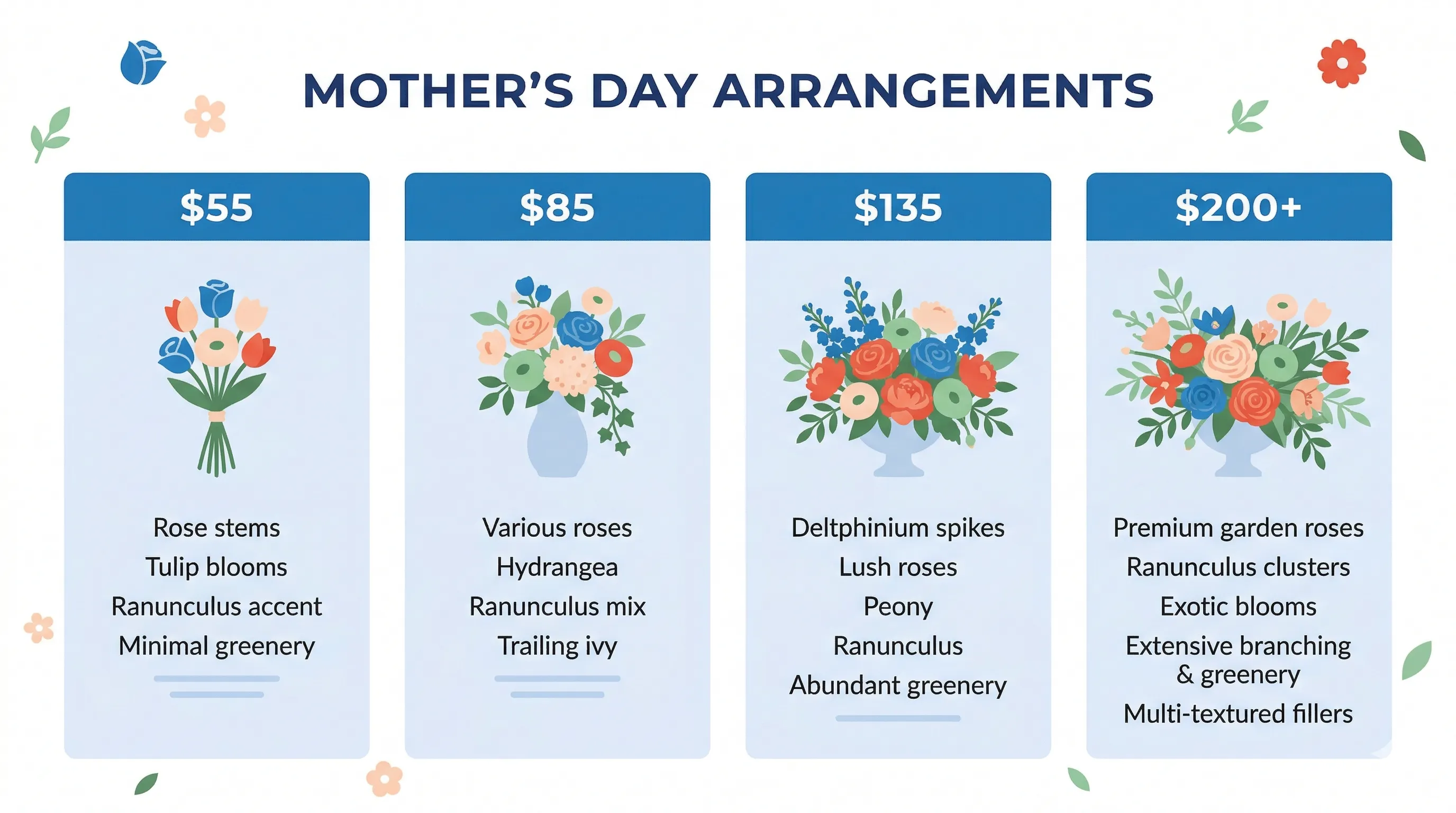
The most efficient approach is a curated menu of four to six standardized designs at different price points. This isn’t about limiting creativity — it’s about channeling it into a small number of designs that are beautiful, reproducible, and operationally manageable at volume.
Here’s a framework for building your Mother’s Day menu:
Start with three to four arrangement styles that span your price range. A common structure is a small arrangement or bouquet at $45 to $65, a medium arrangement at $75 to $100, a premium arrangement at $125 to $175, and optionally a luxury piece or plant-based offering above $200.
For each design, build a complete recipe that includes every stem by variety and quantity, all foliage and filler by type and quantity, the vessel or wrapping materials with specific product codes, any mechanical elements (foam, tape, wire, water tubes), and estimated production time per unit.
Keep the color palette tight. Some of the most efficient shops limit their entire Mother’s Day menu to a single color family — all pinks, all pastels, or all warm tones. This dramatically simplifies wholesale ordering because you’re buying larger volumes of fewer varieties, which means better pricing, less waste, and faster production since designers aren’t sorting through 15 different flower types at the bench.
The Batching Production System
Batching is the practice of grouping identical tasks together instead of completing one arrangement from start to finish before moving to the next. It’s the same principle that makes a commercial kitchen faster than a home kitchen — you prep all the vegetables first, then cook, then plate.
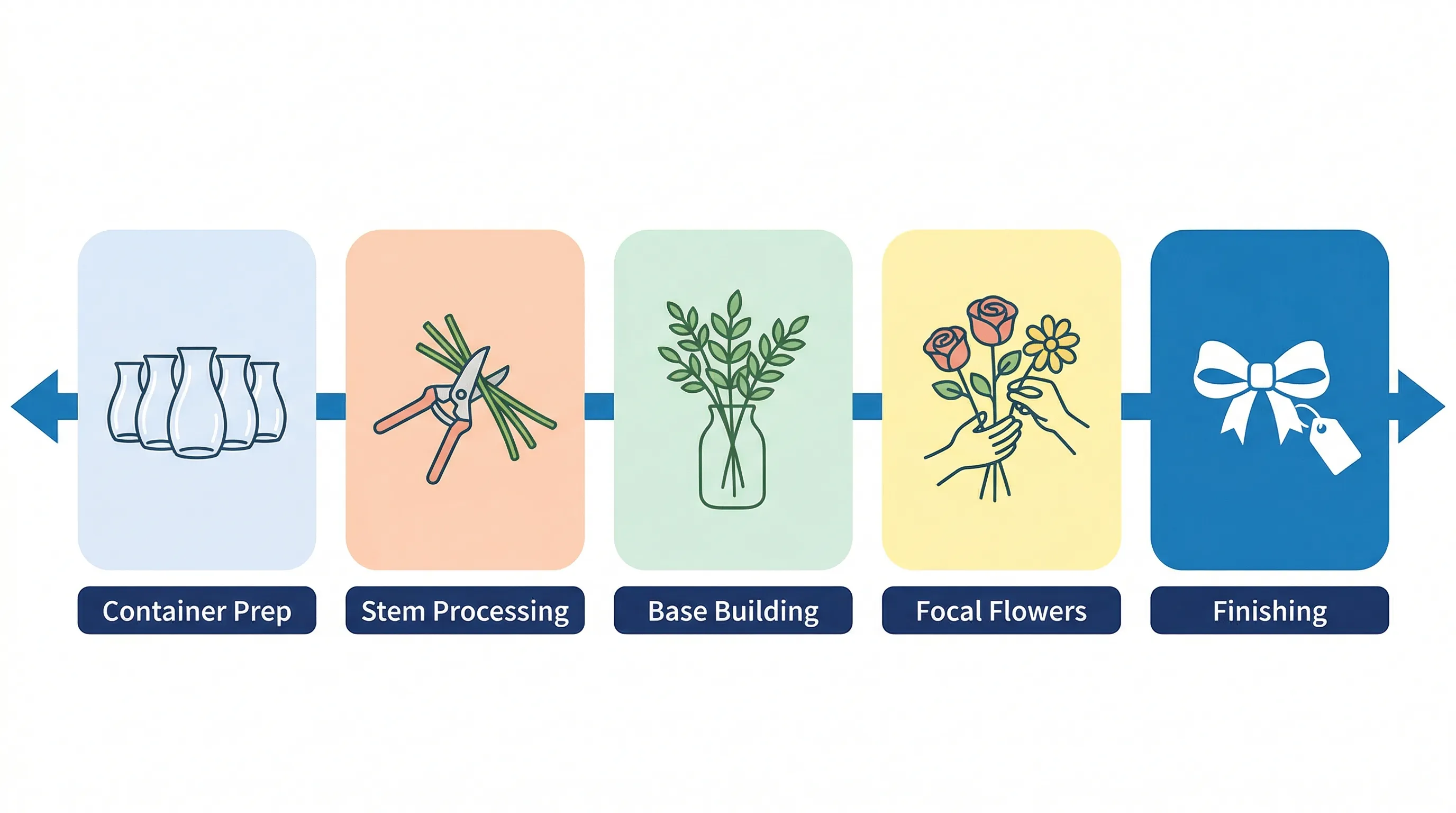
For floral production, batching typically works in five stages:
Stage 1: Container prep. Pull all vessels for the day’s production. Clean them, add foam or mechanics, fill with water, and line them up by recipe type. If you’re producing 30 of your $85 arrangement, that’s 30 identical vases prepped and ready before a single stem gets cut.
Stage 2: Stem processing. Process all flowers at once. Strip, cut, hydrate, and sort by variety. Group them into recipe-ready bundles. If your $85 recipe calls for five roses, three spray roses, four stems of eucalyptus, and two stems of stock per arrangement, pre-count and bundle those quantities into station-ready kits.
Stage 3: Base building. Insert the greenery and structural elements into all containers first. Every arrangement gets its foundation before any focal flowers are placed. This creates consistency in shape and structure across the entire batch.
Stage 4: Focal flower placement. Add the primary blooms to all arrangements. Working in a single pass means you’re making the same creative decisions once and applying them 30 times, rather than reinventing the design each time.
Stage 5: Finishing. Add filler, texture, and final adjustments to all arrangements. Then ribbon, tag, and stage for delivery or pickup.
The time savings from batching are significant. A florist building one arrangement at a time — pulling stems, cutting, placing, adjusting, cleaning up, then starting over — typically spends 15 to 25 minutes per arrangement. The same florist working in batches can often produce arrangements in 8 to 12 minutes each, because the repetitive decision-making and tool-switching time is eliminated.
Across 100 arrangements, that’s the difference between 25 hours of production time and 15 hours. Ten recovered hours in the busiest week of your year.
The Wholesale Order: Buying for Recipes, Not for Hope
Once your recipes are documented, your wholesale order writes itself. Multiply the stem count per recipe by the number of orders you expect for each design, add a waste buffer of 15 to 20 percent for perishable items, and place the order.
This sounds obvious, but the number of florists who order by feel — “I think we’ll need about 200 roses” — rather than by math is staggering. Ordering by feel leads to two expensive outcomes: running out of a key stem mid-production (which forces substitutions, slows the line, and creates inconsistency) or overordering (which means waste, lower margins, and a cooler full of flowers you can’t sell).
The recipe-based approach eliminates both problems. If you know your $85 arrangement uses five roses and you’re projecting 40 orders of that design, you need 200 roses for that recipe alone. Add your waste buffer and the number is 230 to 240. That’s the order. No guessing, no anxiety, no midnight panic calls to your wholesaler.
The timeline for ordering matters too. For Mother’s Day, most wholesale suppliers recommend placing your core order four to six weeks out, with a final adjustment two weeks before the holiday based on pre-order volume. Waiting until the week of Mother’s Day to finalize your order is how you end up paying premium prices for whatever’s left — and whatever’s left is rarely what your recipes call for.
Staffing the Production Plan
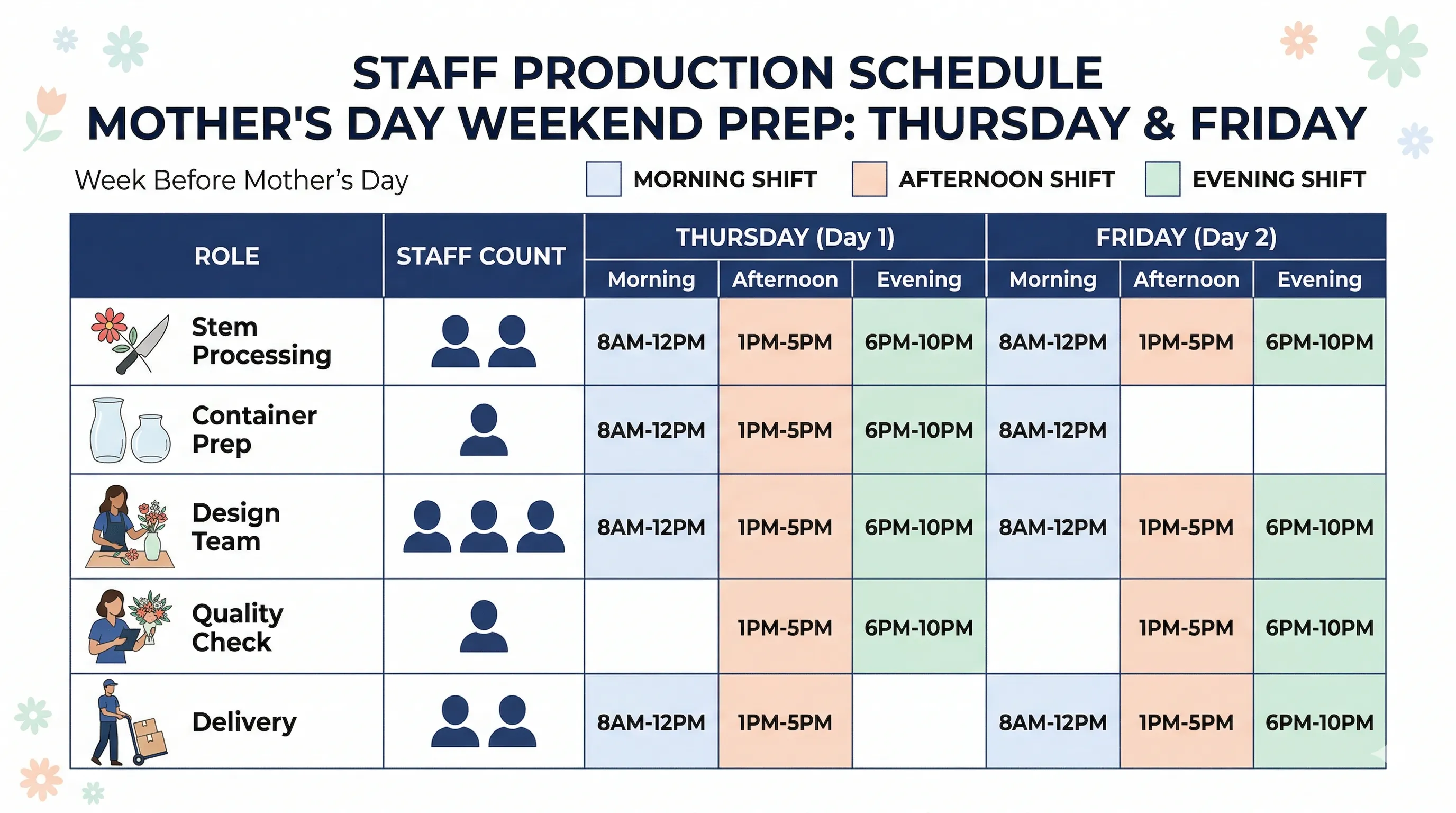
The production plan should dictate your staffing, not the other way around. Once you know how many arrangements you need to produce, at what production rate per batch, you can calculate exactly how many labor hours you need and when.
A useful formula: take the total number of arrangements you expect to produce, multiply by your average production time per unit (using the batched rate, not the one-at-a-time rate), and add 30 percent for setup, cleanup, quality checks, and breaks.
For example, if you’re producing 120 arrangements at an average batched rate of 10 minutes each, that’s 1,200 minutes or 20 hours of pure production time. Add 30 percent and you need approximately 26 labor hours. If you want production completed over two days, that’s 13 hours per day — meaning you need two to three designers working full days, or more people working shorter shifts.
Map your staff schedule against the production timeline. Processing and container prep can often be handled by less experienced staff or temps. Focal flower placement and finishing should be assigned to your strongest designers. Quality checks should be owned by one person who isn’t also producing — ideally the owner or lead designer doing a final pass on every batch before it’s staged.
The Pre-Production Checklist
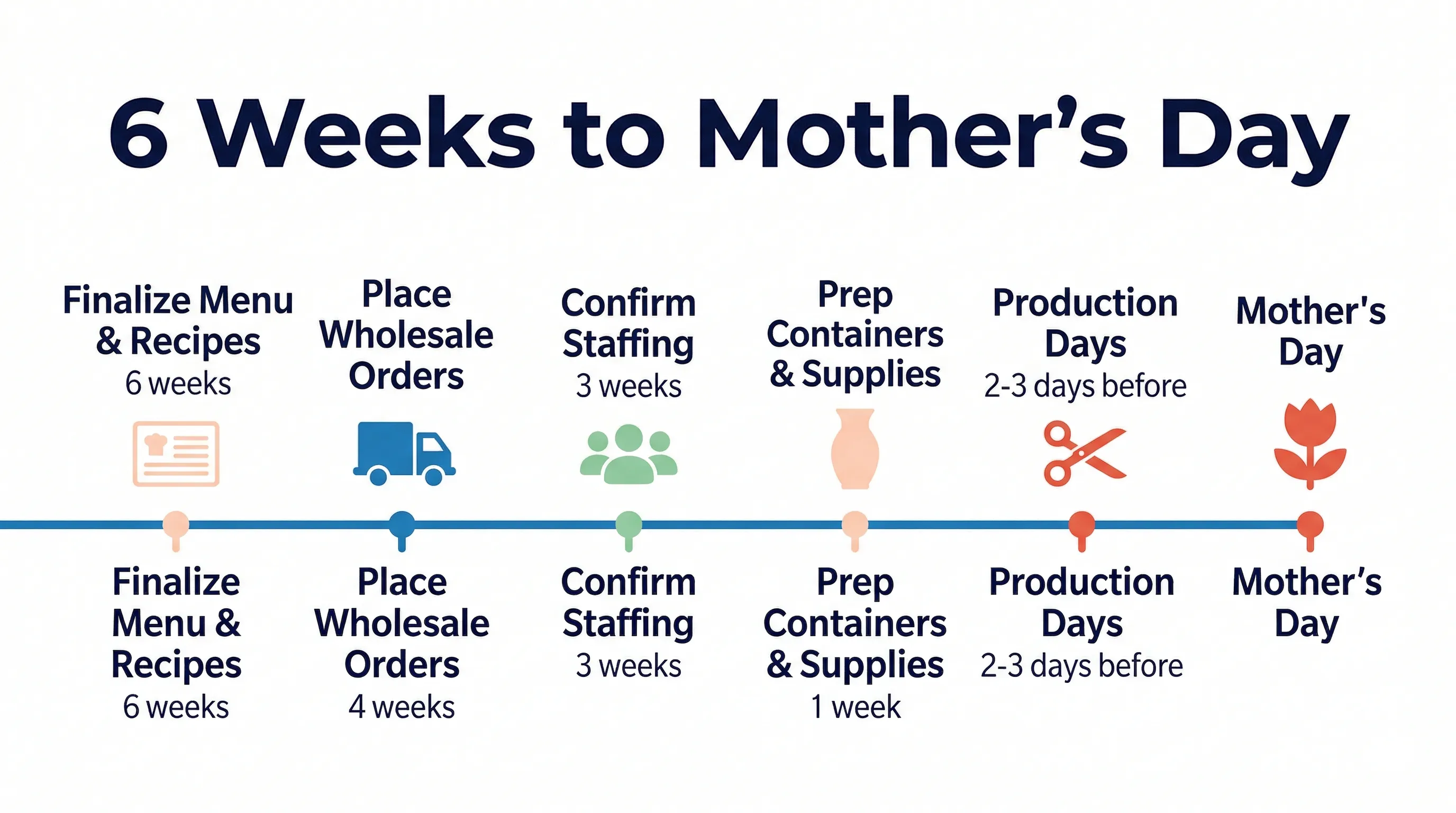
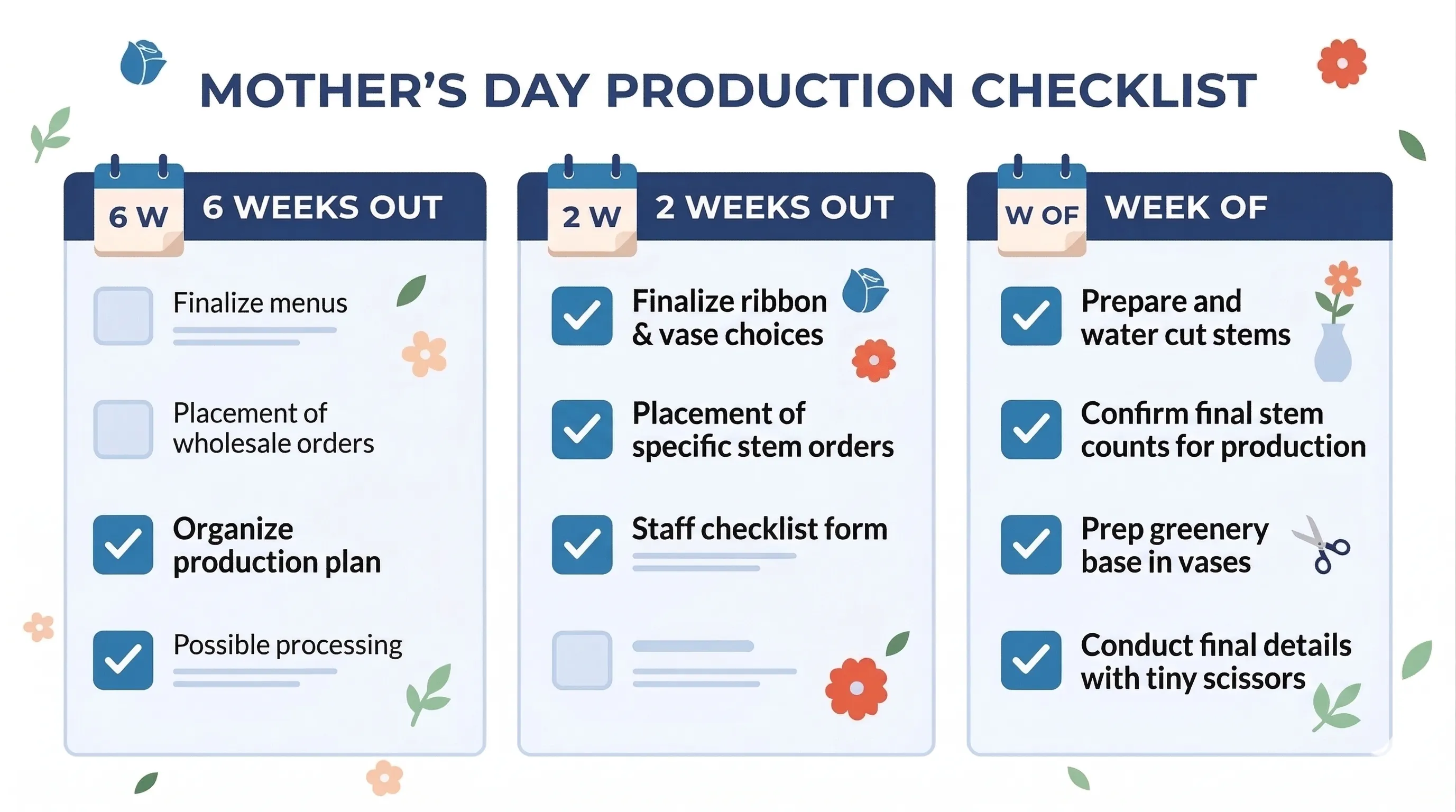
Six weeks out from Mother’s Day, the concrete steps are:
Finalize your menu of four to six standardized designs. Build a complete recipe for each design, including every stem, every sundry, and estimated production time. Photograph or sketch each design for team reference. Calculate total stem and supply needs based on projected order volume. Place your core wholesale order. Confirm staffing and assign roles by production stage. Prep your workspace layout for batched production — stations organized by stage, not by individual arrangement. Set up your pre-order system so customers can order early and you can forecast demand accurately.
Two weeks out, adjust your wholesale order based on actual pre-order volume. Confirm delivery windows with your supplier. Finalize your production schedule with specific time blocks for each stage. Prep containers and mechanics for all projected orders.
The week of Mother’s Day, process and hydrate all incoming stems immediately. Sort by variety and stage in recipe-ready bundles. Run production in batches according to the five-stage system. Assign one person to quality control on every completed batch. Stage completed arrangements by delivery route or pickup time.
What This Looks Like in Practice
Consider two florists, both expecting to fill 100 Mother’s Day orders.
Florist A operates the traditional way. She has a general idea of what she’ll make, orders flowers based on last year’s rough memory, and plans to “just design as orders come in.” By Thursday before Mother’s Day, her cooler is full but disorganized. She’s pulling stems for each arrangement individually, making design decisions on every piece, and handling interruptions from staff who don’t know what goes where. Production takes 25 minutes per arrangement. She works until midnight on Saturday and still has Sunday morning orders to fill. Her waste rate is 25 percent because she overordered some varieties and ran out of others.
Florist B uses the recipe-batching system. She finalized four designs six weeks ago, built recipes, and placed her wholesale order based on exact stem counts plus a 15 percent buffer. Her containers were prepped on Wednesday. On Thursday, her team processes all stems in the morning and builds greenery bases in the afternoon. On Friday, two designers place focal flowers while a third finishes and stages. Production averages 10 minutes per arrangement. She’s done by 6 PM on Saturday with Sunday morning reserved only for last-minute orders and delivery coordination. Her waste rate is 10 percent.
Same order volume. Same team size. Completely different experience — and completely different margins.
Building the System That Lasts Beyond Mother’s Day
The production planning approach that works for Mother’s Day is the same approach that works for Valentine’s Day, for holiday season, and for any high-volume period in your business. The investment you make in building recipes, standardizing your menu, and training your team on batched production pays dividends every time volume spikes.
The florists who treat Mother’s Day as a one-time sprint end up rebuilding from scratch every year. The ones who treat it as a reason to build a real production system end up with a competitive advantage that compounds over time.
Start with the recipes. Everything else follows from there.
Want to see what recipe-based production planning looks like inside a system built for it? Curate helps event florists build recipes, calculate stem counts, and manage production workflows — so your Mother’s Day prep lives in one place instead of scattered across notebooks and spreadsheets.